Repeat These Words

repeat
It’s harder than ever to pray
God’s heard it so often before,
I don’t want to repeat myself,
I’m afraid of being a bore
And some things I just cannot say.

It’s not easy getting to grips
With eternity and infinity,
I don’t want to repeat myself,
But rather to complete myself,
But how should I speak of divinity
If God doesn’t open my lips?

The words have endured wear and tear,
While I worship, petition and bless.
I don’t want to be insincere,
I wait for the meaning to reappear,
Sometimes I believe more, sometimes less,
And I’ve nothing, at times, to declare.

If my mouth will declare Your praise
The language may fashion the thought,
And the words of supplication
Determine the meditation
To which they gives support
Through each time-honoured ancient phrase.

At times, when my heart’s in my mouth
I’m in tune with a great cosmic beat
Then I don’t believe that I cheat myself
It’s all right to repeat myself,
It’s different each time I repeat,
With my right hand, yemini, to the south.

The Asked-For King

1 samuel 10
Anointed by Samuel, judge, seer and cleric,
Saul fell among prophets all speaking in tongues,
Impressionable, highly-strung and hysteric,
Saul prophesied too at the top of his lungs;
Prophets back then were obscure and elliptic
In trance-like states they shouted or muttered,
Unlike Samuel who, while being cryptic,
Was generally clear in such words as he uttered.
Now Samuel assembled the people and said:
‘Though God saved you from Egypt and slavery’s yoke,
By a fallible mortal you choose to be led,’
As if chilled at the thought, Samuel tightened his cloak.
He said ‘Lots will be drawn, tribe by tribe, clan by clan,
Then your king will be known by the lots, where they fall,’
Thus the search for the first king of Israel began
And the lot clearly fell to a Benjamite, Saul,
And up went the cry, ‘Where is Saul? He’s not here!’
He had fled from the noise, the acclaim of the crowd,
To hide among bags used for storing some gear
For it pained him to hear his own name called aloud.
They found him quite soon and the crowd was delighted,
Shouting ‘Long live the king!’ as if with one voice,
Even Samuel for once in his life grew excited,
Saying, ‘Look at the man who is truly God’s choice!’
Just a few made expressions of cynical doubt:
‘Can he save us in war? There’s not much he can do,
He lacks all authority, confidence, clout,’
Saul did not respond, but he heard and he knew.

Sempervirens

sequoia
There is a hollow part of me
Which is not mother, daughter, sister, lover,
It is not friend, it is not colleague,
It is not stepmother, it is not widow,
It is not divorcee, it is not pensioner,
It is not customer or bookseller
Neither is it the woman in the restaurant
Or in the auditorium
Or the woman in that long queue
Which you don’t see in men’s toilets,
Neither is it the reader or the voter;
Nor the blogger, nor the tweeter;
The solid branches of my life
Grow strong and dense from the hollow trunk
Which Sartre called The Transcendental Ego,
Analysts and therapists
Try in vain to penetrate
Yet with age the trunk solidifies,
Rings displayed in the tannin bark
Like a sequoia tree, sempervirens,
Evergreen and sempiternal
Ever living, ever dead,
Hollow as I live and breathe,
Until breath yields to opacity.

10 December 2013

Saul is Anointed

saul-anointed-by-samuel
We are told the young man is beautiful
Unrivaled among his peers
We can tell he is dutiful,
Obedient, despite his thirty years,
To find his father’s asses is his task,
Unaccountably, they strayed,
This young man whose name means ‘ask’
Always comes to his parents’ aid.
We are told he is unusually tall
Head and shoulders above the rest
So this young man we know as Saul
Appears exceptionally blessed.
His errand is unsuccessful,
He lacks a sense of direction
He gets lost, which he finds stressful,
He is not entirely perfection.
He tells his servant ‘We’ll turn back,
Give up the asses now as lost,’
The lad answers ‘Further up the track,
And for just a little cost,
A man they call the seer will advise.’
But Saul has now run out of cash.
The servant says ‘Come on, the man is wise,
And I always carry a stash.’
Saul at times tends to be passive,
And readily he obeys
The lad, whose chutzpah is massive.
We begin to glimpse Saul’s malaise.
Three or four young women come into sight,
They stop when Saul asks the way,
Determined to assist in his plight –
You don’t see men like Saul every day.
Saul’s party at last reaches the town.
Where Samuel the prophet, meets them;
He notes the man whom he must crown
And, with solemnity, he greets them.
They accept his hospitality
And Samuel speaks to Saul alone,
Explaining the reality,
Saul is destined for the throne.
‘Since you,’ he says ‘have been appointed,
I have ready a cruse of oil
From this moment you are God’s anointed,’
The seer fails to see Saul recoil.
Samuel is nothing if not directive,
He tells Saul what he must do,
And Saul achieves his objective
For the asses are recovered too.

Circuit Judge

infant samuel

That charming biddable infant, Samuel,

(The child whose mother made a little cloak)

Raised in the Temple by Eli the priest

Precocious on the rare times when he spoke;

This boy grew to manhood in troubled times

The Philistines menaced Israel every year

They wanted to offload the Holy Ark;

The trophy evoked superstitious fear;

Now Samuel was a jack of many trades:

Able to slay a sacrificial beast

And make the offering on the altar,

Circuit judge, General, seer, acting priest.

His beard was sparse and fair and he was young,

Twenty-four, and the Israelites would joke,

‘The judge is twelve years old,’ they used to say,

To add gravitas, he would wear a cloak.

His mother, Hannah, was still living then –

She had a house in Rama; when she died

Samuel took up residence in the house.

All Israel looked upon him as a guide.

Samuel’s two sons, like Eli’s, were delinquent

Samuel, not so young, became grey of beard;

And still the Philistines grew in number,

While Israel, without respite, watched and feared.

One day a crowd showed up in Rama,

The elders of Israel, quite a gathering;

Samuel emerged and asked what they wanted.

They said ‘Give us a king! Give us a king!’

God spoke to Samuel, which was how things worked,

And told him ‘Give the people what they ask,

It is I, Anochi, whom they reject,

Not you,’ but still Samuel abhorred his task.

‘A king,’ he told the crowd, ‘will take your sons,

And your daughters and use them as his slaves,’

But who can dissuade a mob with reason?

Be heeded by a crowd which rants and raves?.

To be like other nations, they avowed,

This was what they wanted; this was their thing.

Samuel perceived their fervour with dismay.

‘Give us a king!’ they roared. ‘Give us a king!’


The Ark is Taken

Eli

Eli the priest at Shiloh
Corpulent, narrow eyed, benign
Imparted to Hannah’s child
Instruction holy and divine.
The adult sons of Eli
Were self-indulgent and malign;
On the sacrificial meat
They battened with the greed of swine;
They looked on the pilgrims’ wives,
Their expressions were saturnine.
None of this did Eli see
Or advanced age made him supine.
He was absorbed by Samuel,
The infant serving at the shrine.

These two sons – one was Hophni
And Phineas the other’s name –
Grew in arrogance and pride
While Eli spoke no word of blame.
A prophetic man of God
Came before Eli to proclaim
Both sons would die by the sword,
Shiloh would never be the same,
Eli would have sight of war,
With devastation, loss and shame.
The Philistines grew stronger
But chose to play a waiting game.
The Israelites lived in fear
And dreamed of iron, sword and flame.

The boy Samuel lay awake,
The Temple was not fully dark;
In the sanctuary a lamp
Still burned above the Holy Ark.
He heard someone call his name
The child sat up and whispered ‘Hark,
Whose voice is that?’ then, bravely,
‘Here am I,’ was his prompt remark.
He ran to Eli: ‘Master,
To serve you, I rise with the lark.’
Eli said ‘It was not I
But God who called; some sacred spark
Enables you to hear God’s voice,
Like Abraham, our patriarch.’

Samuel was obedient,
He always did what Eli said,
He returned to his alcove
And lay down on his narrow bed.
Soon he heard God call again
And, overcoming natural dread,
Samuel spoke, said ‘Here I am,
I shelter where your wings are spread,’
God said Eli’s house was doomed,
The corrupt sons would soon be dead.
At sunrise, Eli rose up,
Approached the child with heavy tread,
Enquired about God’s words,
Was answered and was not misled.

The Philistines now mustered,
Deploying a large battle force.
The Israelites were routed –
The foe had chariot and horse.
The troops of Israel withdrew,
They saw they could not stay the course;
The elders were consulted
And said ‘Willingly we endorse
Taking the Ark from Shiloh;
In the fray, it will reinforce
The courage of our fighters,’
They believed the Ark to be a source
Of martial power; in this
They blasphemed, but felt no remorse.

The elders gave poor advice.
The men of Israel charged again,
Thirty thousand fell that day,
Hophni and Phineas were slain;
The Philistines took the Ark,
One Benjamite, a bloody stain
Seeping fast through his tunic,
Ran to Shiloh despite his pain,
Told Eli the Ark was lost
And Israel’s glory on the wane;
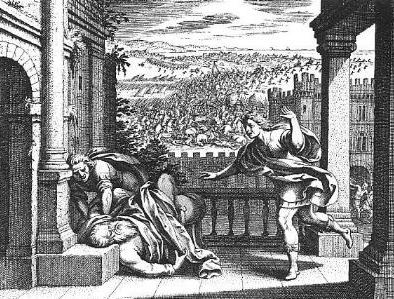
The old man fell from his chair
His body could not take the strain,
He died. The Benjamite said
‘Baruch Dayan ha emet, amen.’

Eli’s son’s wife was pregnant,
She raised her voice to weep and wail,
Hearing Phineas was dead
And at once commenced her travail,
But her strength deserted her,
Her labour seemed to no avail
In the hour before dawn
The baby came, a healthy male,
The mother, close to death, said
‘My child will live, I did not fail,
Call him Ichabod which means
“Glory is exiled from Israel.”’
Saul the Benjamite heard this
And he survived to tell the tale.

August 2013

Hannah in Shiloh

hannah
‘A drunken woman,’ thought the priest,
Though wine but rarely touched her lips
She was afflicted by a rival,
Loud and bossy; fertile hips:
Peninnah, whose name meant Ruby
She too was wed to Elkanah
And bore four children in four years
Even so, he preferred Hannah;
The quiet of her chamber pleased
More than the bustle and the noise
Which accompanied Peninnah,
With her quartet of healthy boys.

In the Shiloh Temple one night
Hannah cried while she mouthed her prayer,
And Eli watched with narrowed eyes
But did not leave his priestly chair.
She petitioned God in silence
God hears the heart and does not need
To hear the mouth speaking words
Or see the blood to know we bleed.
But Eli, just a priest, not God,
Thought she was inebriated
Regarding her with cold distaste
While she wept and supplicated.

‘May God who remembered Sarah.
Let me, like Sarah, bear a child,’
At last the priest rose from his seat
‘Woman, your drunkenness defiled
The holiness of this precinct
Next time your entry will be banned.
When will you rid yourself of wine?
Remember before whom you stand.’
‘Do not think your handmaid worthless,’
She answered, hastily composed,
‘To the Holy One, Blessed be He
My silent prayers are now disclosed.

And if indeed I bear a son,
He’ll be God’s servant all his days,
He’ll come to Shiloh, here to learn
Mosaic law and righteous ways.’
Then Eli answered ‘Go in peace,
And in God’s eyes may you find grace,’
Hannah went home to her husband,
New radiance was in her face.
She ate with appetite for once
And mopped up gravy with her bread,
Elkanah yearned towards his wife,
He took her to the marriage bed.

A male child was conceived that night.
At last, at last, Hannah gave birth,
Samuel she named her infant son,
Her heart knew gratitude and mirth.
And when the child was fully weaned
She recalled how God heard her voice
She went to Shiloh to the priest,
‘This lad is mine and I rejoice
That the Lord opened up my womb,
I honour now the vow I made,
The lad will stay and serve you here
The parting cannot be delayed.’

Hannah then returned to Ramah,
The child resided with the priest
Six children in all Hannah bore,
Her fruitfulness was much increased.
Her husband praised her at the gate,
The other wife ceased to provoke,
Hannah saw Samuel once a year,
She always brought a little cloak;
She sewed these cloaks with dexterous craft,
Maternal love and some regret
That Samuel now was lent to God.
Observe the cloak. Do not forget.

Michal and Paltiel

paltiel

When Saul my Dad was still the king and David on the lam,
An outlaw and a mercenary, Saul found me a new man
There’s the dynasty to think of if your father wears the crown
So I was wed to Palti with a chuppah at sundown,
An espousal true and kosher, to husband number two
And David out in Ziklag with his men, the happy few.
They brought me into Palti’s tent and wham bam thank you ma’am
So later I was rather touched to find he gave a damn
He meant to show affection but just didn’t have the knack,

And walked behind me weeping when David claimed me back,
Now why did Palti shed the tears while David was dry-eyed?
I was a wife to both of them, the trophy princess bride,
The fact I had no children was a setback for King Saul
It looked as if our dynasty was going to the wall;
This suited David who despatched without much fuss or noise
The remnant of our family, my sister Merab’s boys.
He gave them to the Gibeonites who hanged them, every one
And the royal hopes of Benjamin were finally undone
While my nephew, Mephibosheth, son of Jonathan, the prince
Lost half his land to Ziba and we haven’t seen it since.
It’s fishy how King David got Saul’s grandsons out the way
He took me back from Palti, like some slave who’d gone astray,
He’d taken younger wives and, though he spent his nights with them,
I’d say he only loved himself, and possibly Hashem…
So the tribe of Judah lives to tell the tale and write the scroll
And cast themselves forever in a messianic role
With Saul, my Dad, bipolar, or so the bible shows
And Paltiel, the husband, whose name nobody knows.

A.N.B. [1990]

Arthur

Yeshiva boy from Hackney,
Seventh child and fatherless,
Took odd jobs to make ends meet,
Sold high boots to ballet dancers,
Without conviction.

Then came World War II,
Volunteered for the navy,
Got the army, London Scottish,
Thus obliged to wear a kilt,
Against prediction.

Sergeant-major, Desert Rat,
Drove a tank and shot point blank,
Rescued men from burning huts,
Awarded military medal,
Better than fiction.

Italy in forty-four
And forty-five, active service,
Meeting Pope Pius XII
Picking up fluent Italian
And a shrapnel affliction.

Demobbed at last, a waiting wife,
A mother dead, he buries gongs
Of distinguished service by her grave,
To such mementos of glory,
He lacks addiction.

Post-war, he shuns jingoism,
He who waved his Union flag
At primary school on Empire Day
And anglicized his first name
For acceptability.

Revered in North London,
Elder of the synagogue,
Personal tragedy ravaging life,
Keeping a stiff upper lip,
That English ability.

Full of days, one man Sanhedrin,
Still at hand for those in need,
Lifeline for the devastated,
Fourscore years are in his sights,
Shows equanimity.

Small in stature, slight of build,
Ashen faced on Yom Kippur,
Tallit at the Neilah service
Covering his hairless head
In touch with divinity.